
San Mateo County News Rhythms
Arrest reporting in San Mateo County is spread across many publishers. San Mateo Police puts out selective, event-based press releases. Daly City Police sends a crime newsletter most weeks, mixing incident narratives with statistics. Redwood City Police keeps media logs that roll back about 30 days. The Sheriff's newsroom covers the county with releases and press logs. None of these amount to a full jail roster, and none promises booking photos.
Timing matters when you read any of them. A Daly City newsletter may describe something days after it happened. A Redwood City item can drop out of its 30-day window while the case is still open. San Mateo's hub skips routine events entirely, since publication there is selective. Start with the agency that handled the incident. Then ask whether the person actually entered county custody. Citations, field releases, hospital handling, and quick releases can all keep a name out of a current-custody search.
| Official outlet | Coverage | Photos? | Where |
|---|---|---|---|
| San Mateo Police | Event-based releases, not a daily log | May use scene or evidence images; no photo roster | Press releases |
| Daly City Police | Generally weekly incident newsletters | No booking photographs advertised | Crime Alert Bulletins |
| Redwood City Police | Rolling 30-day police activity | No mugshot feed advertised | Media logs |
| County Sheriff | Selected releases and press logs | Varies by release and law | Sheriff newsroom |
Note: Publication date, incident date, booking date, and court filing date can describe four different points in one case.
San Mateo County Crime Outlets
For independent county coverage, the San Mateo Daily Journal stands out. Its police hub runs short incident roundups with locations or block numbers and reported times. Roundups tend to show up roughly weekly, though that's a pattern rather than a promise. The paper's local-news section publishes arrest and prosecution stories more often, credited to police departments, the Sheriff, the District Attorney, staff, or Bay City News. Images appear now and then, but they don't add up to any systematic booking gallery.
Redwood City Pulse keeps a crime archive focused on Redwood City, Menlo Park, North Fair Oaks, and nearby areas. It leans on police releases, the District Attorney, or Bay City News, and usually runs agency or scene photos. One July 2026 story noted that the outlet waits to name suspects until charges are filed. That policy keeps a reported event separate from a filed case. Patch's San Mateo page contributes episodic Crime & Safety items, often built from San Mateo Police releases, though no stable crime archive covering all three cities turned up.
| Outlet | Coverage | Photo pattern | Use |
|---|---|---|---|
| San Mateo Daily Journal | County police roundups and local stories | Varies; no systematic mugshot gallery | Incident and prosecution context |
| Redwood City Pulse | Frequent Redwood City-area crime reports | Mainly agency or scene images | City-specific reporting |
| Patch San Mateo | Episodic local Crime & Safety stories | Often stock, scene, or agency material | Secondary event coverage |
A news report can tell you which agency made the arrest, when and where an event took place, and what context the reporter gathered. It cannot tell you whether someone is in custody right now. It also cannot tell you how a case ended. Those answers live with the Sheriff and the Superior Court.
San Mateo County News Mugshots
Booking photos are taken at jail intake, yet the San Mateo County inmate locator doesn't advertise any photo field. An outlet might get an image through an agency release or a focused records request. Publication is never automatic. California Government Code section 7923.610 lists arrest facts agencies must disclose within stated limits, but the booking photograph isn't expressly on that list. A requester should name the specific image wanted and let the agency apply its rules and exemptions.
California Penal Code section 13665 goes further, restricting many law-enforcement posts of nonviolent-arrest booking photos on social media. Fugitive cases, imminent threats, court orders, and urgent circumstances are excepted. Covered posts generally must come down within 14 days once an exception no longer applies. Agency websites and electronic systems sit outside that rule. This is why social media accounts make poor stand-ins for a complete arrest feed, and why a news image may not stay online.
Trace San Mateo County Arrest News
A story captures one moment. The county record chain fills in what came later. The Sheriff locator tracks current custody, not a permanent arrest archive. San Mateo County also has no verified public 24-hour, 48-hour, 72-hour, or weekly Sheriff bookings feed. For the fuller county feed and the records-request process, see the San Mateo County booking records hub.
- Read the story closely. Record the full name, incident date, city, arresting agency, and any report or case number.
- Check the official city log, newsletter, or release. It may provide the agency’s own account and clarify whether an arrest was reported.
- Search the Sheriff inmate locator if the person may still be in county custody. A missing result can reflect release, transfer, withholding, spelling, or timing.
- For a released person, request the Sheriff daily log or a targeted booking record. Ask separately for a booking photo because the listed public fields do not include one.
- Search MIDX for the filed case, then use Odyssey or the clerk for the register of actions and disposition. Do not merge booking and court charges as if they were one record.
Follow the sequence. A police statement, jail intake, custody status, a charging decision, and a court outcome are all separate stages. If records disagree with each other, keep their dates and procedural stages in view. The later court disposition is the authority on how the case ended.
San Mateo County Court Timing
Penal Code section 825 sets the basic clock. An arrested person must see a magistrate without unnecessary delay, and within 48 hours. Sundays and holidays don't count toward that total. Court-session rules add more qualifications. So the 48 hours isn't a promise of exact clock time. A news story saying someone was "booked" can run long before arraignment, before filing decisions, and before any updated charge record exists.
MIDX searches cases by number or by person. It also supports short searches by filing date. Results give index details like the case number, party, filing date, and source. The Odyssey Public Portal goes further, with fuller register-of-actions information for public, nonsealed criminal cases. Criminal documents themselves generally aren't displayed remotely, though. For older criminal matters filed before 1993, contact the Criminal Clerk.
Note: A news headline may remain unchanged after prosecutors amend charges or the court records a dismissal, plea, acquittal, or conviction.
Unofficial San Mateo County Arrest Pages
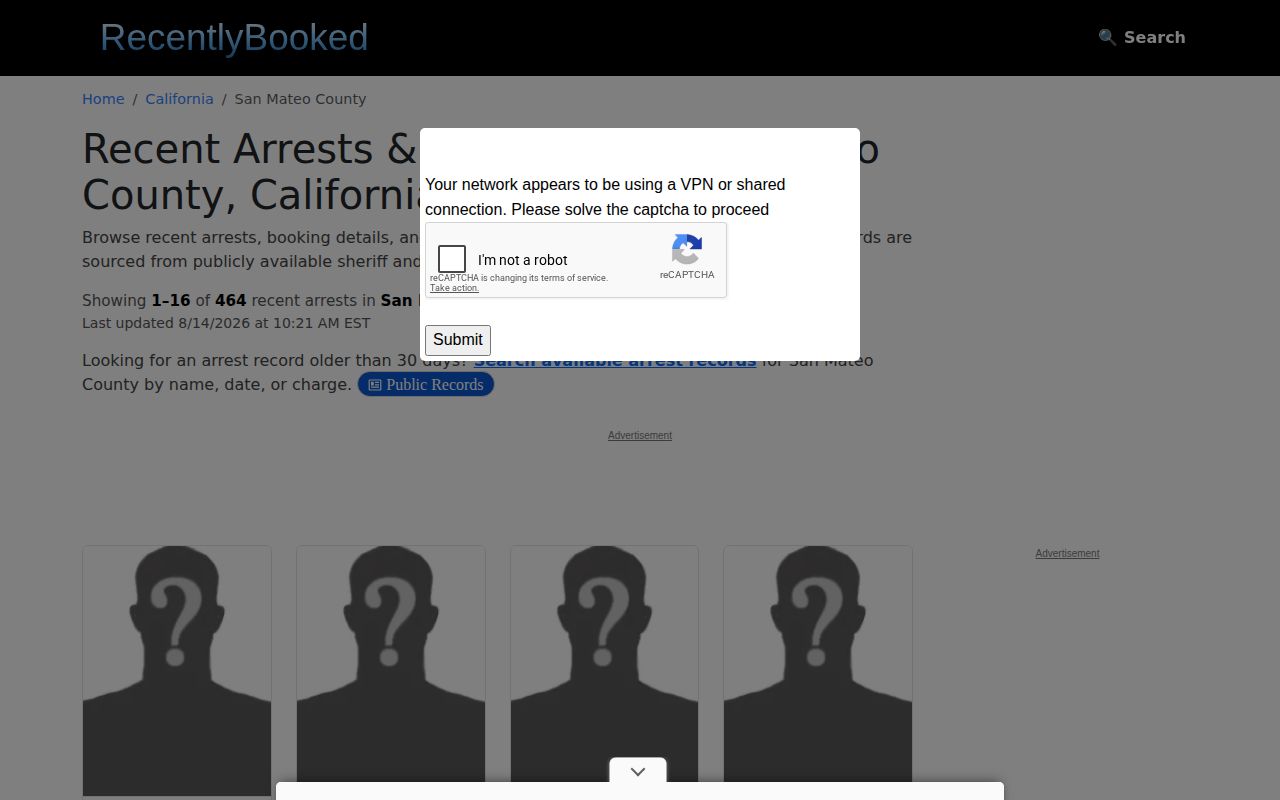
Some commercial sites gather San Mateo County arrest data on their own. Recently Booked is the clearest example. Its county section shows bookings from a rolling 30-day window. Each update carries a refresh time stamp. There is one catch. The site itself notes that the county does not release mugshot images. Entries may list booking details and charges, but agency attribution is often spotty. Treat it as a starting point, not the final word. Visit the live Recently Booked San Mateo County section with that limit in mind.
Mugshots.com works differently. Its verified county section skews old. Entries cluster between 2004 and 2016. So it is an archive, not a feed of recent arrests. City labels appear on many entries. Still, they say nothing about who is in custody now or how a case later resolved. Approach the Mugshots.com San Mateo County archive as an unofficial historical lead.
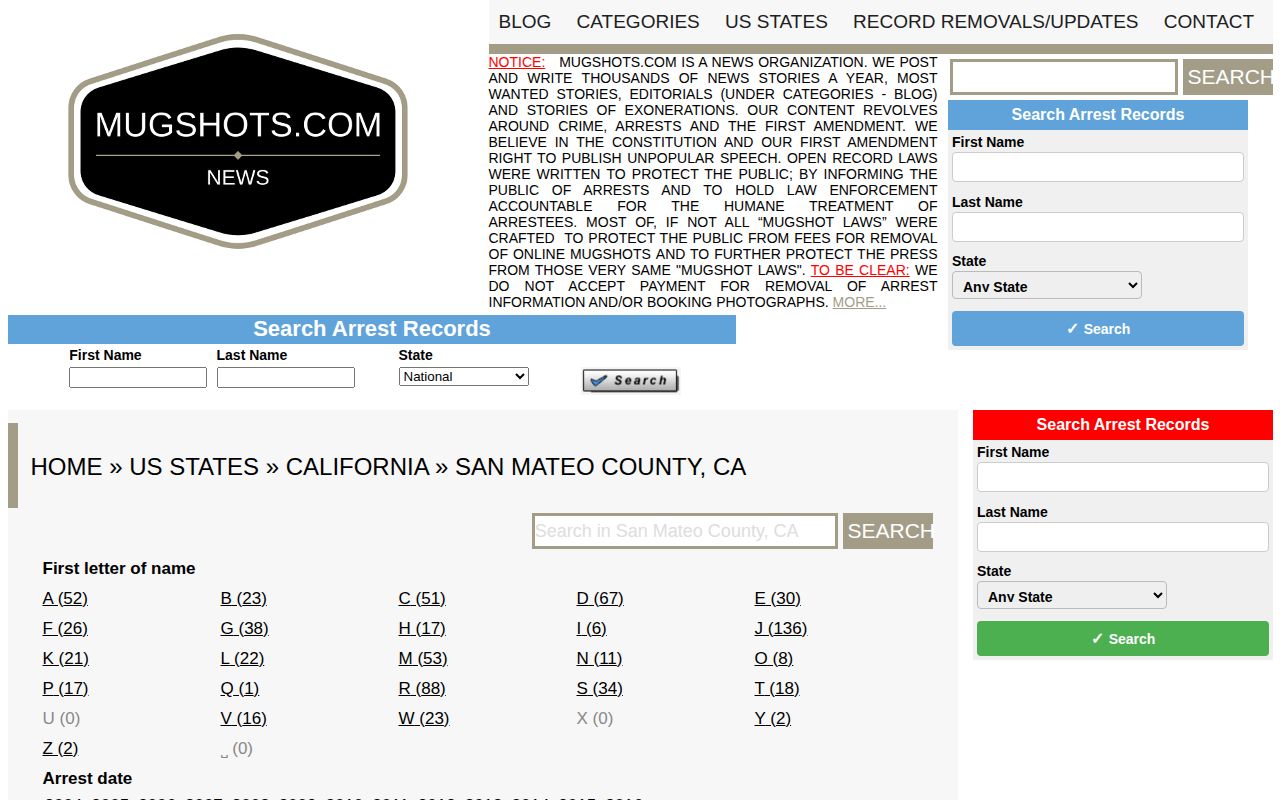
A screenshot of the archive interface shows only that the section exists. It cannot confirm that an older entry still reflects a current warrant, custody status, or charge. Treat what you find there accordingly.
San Mateo County Coverage Gaps
Busted Newspaper, Arrests.org, and Mugshots.zone have no verified San Mateo County section. Be careful with lookalike results. A listing that shows "San Mateo" as a city may describe a booking that happened in a different county entirely. Skip guessed local addresses and generic search pages. The official feeds have gaps too. The Sheriff Crime Data Portal covers incident data, not jail bookings. City newsletters, logs, and press releases help, but none adds up to a full county roster. Need a tight date range? Request the Sheriff's daily log. Researching someone already released? Combine the arresting agency's record, a focused Sheriff request, and the court file.
Match San Mateo County Arrest Sources
Pick the city source that fits the event you are checking. San Mateo's page highlights selected releases. Daly City's newsletter runs weekly summaries, so compare the issue date with the incident date. Redwood City posts a 30-day media log. That log works as a rolling window on police activity. In any city, a county booking happens only when the Sheriff accepts the person into custody. For a deeper local path, the Redwood City busted mugshots record path ties the official media log to Sheriff custody and court follow-up.
The same logic applies across San Mateo and Daly City. Police publication, county booking, and court outcome are three separate records. News stories add color. They cannot stand in for those layers. Unofficial data gets duplicated, stale, or detached from what actually happened. So verify custody with the Sheriff, incident facts with the arresting agency, and the outcome with the court.