
San Mateo County Busted Mugshots
A San Mateo County busted mugshot starts behind jail walls. The Sheriff's Office handles booking once someone enters county custody. Fingerprints come first. Then a photograph. Charges and identifying details land in a file tied to a booking number. City police can make the arrest, but custody hands the file to the Sheriff.
What the public sees is only a slice of that file. Sheriff training materials describe tools like ATIMS booking software, a mug-shot camera and computer, fingerprint gear, and separate tattoo photography. The official inmate locator lists no image among its published fields, though. So a mugshot can sit in the booking file and never surface online. That gap matters. A quick custody check answers one question, while a records request asks the Sheriff to review a specific file for release under California law.
San Mateo County Booking Fields
Three different products hold three different sets of facts. California Government Code § 7923.610 names the arrest information law enforcement must disclose, within safety and investigative limits. The Sheriff's daily log adds local operational fields on top. The public locator offers the smallest set, geared to current custody. None of these amounts to an automatic public mugshot gallery.
| Field | What it shows |
|---|---|
| Name and identifiers | The person associated with the entry; date of birth or a booking number can separate similar names. |
| Booking number and date | The intake event that connects the arrest, fingerprints, internal photos, and later records. |
| Arrest details | The agency, place, time, and factual circumstances reported for the arrest. |
| Charges and holds | Charges entered at booking, plus warrants or probation and parole holds. These are not findings of guilt. |
| Bail and status | A changing custody fact, including bail, release information, or the present holding state. |
| Facility | Maguire Correctional Facility or Maple Street Correctional Center while the person remains in county custody. |
| Next court date | A scheduling aid that should be checked against the Superior Court because dates can change. |
| Booking photograph | An intake image tied to the booking file, although it is not an advertised locator result field. |
The statutory arrest facts cover a lot of ground. Occupation, physical description, arrest and booking times, location, bail, release manner, holding place, charges, and specified holds all qualify. Notice what's missing, though. A booking photograph is not expressly listed. When a mugshot is the goal, ask for it by booking number. That keeps the statute's arrest-fact rule from becoming a promise that every image gets handed over.
When Is the Busted Photo Made?
The busted photo is made at jail intake, not when an officer first takes a report. San Mateo County training treats ATIMS data entry, fingerprints, mug-shot camera work, and tattoo photographs as separate intake skills. That sequence explains a lot. A city press release can hit the news before the jail record is complete, and a citation with field release may never produce a locator entry at all.
Getting booked is not getting published. Once intake finishes, the booking number ties the image and other identifying material together inside the Sheriff's internal system. Publication is a separate decision. The live locator may show a person's facility, pending charges, custody status, next court date, and bail while the mugshot stays offline. For the image itself, identify the booking first. Then send a narrow request to Records.
Note: A delay or missing locator result can reflect processing, release, transfer, withholding, or spelling, not proof that no arrest occurred.
Request San Mateo County Booking Records
The Sheriff takes California Public Records Act requests several ways: through its online public-records route, by email at sheriffs_recsup@smcgov.org, by mail, or at the records counter. Nothing requires a written request. Writing one anyway helps. It cuts down on mistaken identity and spells out exactly which items you want. Ask separately for the releasable arrest or booking record and for the booking photograph tied to that event.
- Gather the full name, booking or arrest date, booking number if known, and arresting agency. Include date of birth only when lawfully known and needed to distinguish a similar name.
- Describe the specific record and image. Ask for “the releasable booking/arrest record” and “the booking photograph associated with booking number” rather than all files about a person.
- Request electronic delivery. Paper reproduction starts at ten cents per page, but no fixed Sheriff booking-photo fee has been published.
- If material is withheld, ask for the statutory basis and for any reasonably separable, nonexempt portion to be released.
- Use the separate Request for Information route, with identification or authorization, when seeking one’s own report or acting as an involved party or attorney.
California law generally gives an agency ten calendar days to decide whether a request seeks disclosable records it holds. Unusual circumstances can stretch that by fourteen more days. Keep one thing in mind, though. The deadline governs the decision, not the delivery. What Records can actually release depends on safety, privacy, investigative, juvenile, confidential, and sealed-record rules. No blanket San Mateo County promise covers every booking photo.
San Mateo County Sheriff’s Office, Records330 Bradford Street
Redwood City, CA 94063
Records Bureau: 650-363-4525
Central counter: Monday through Friday, 7:00 a.m. to 5:45 p.m., except holidays
California Busted Mugshot Laws
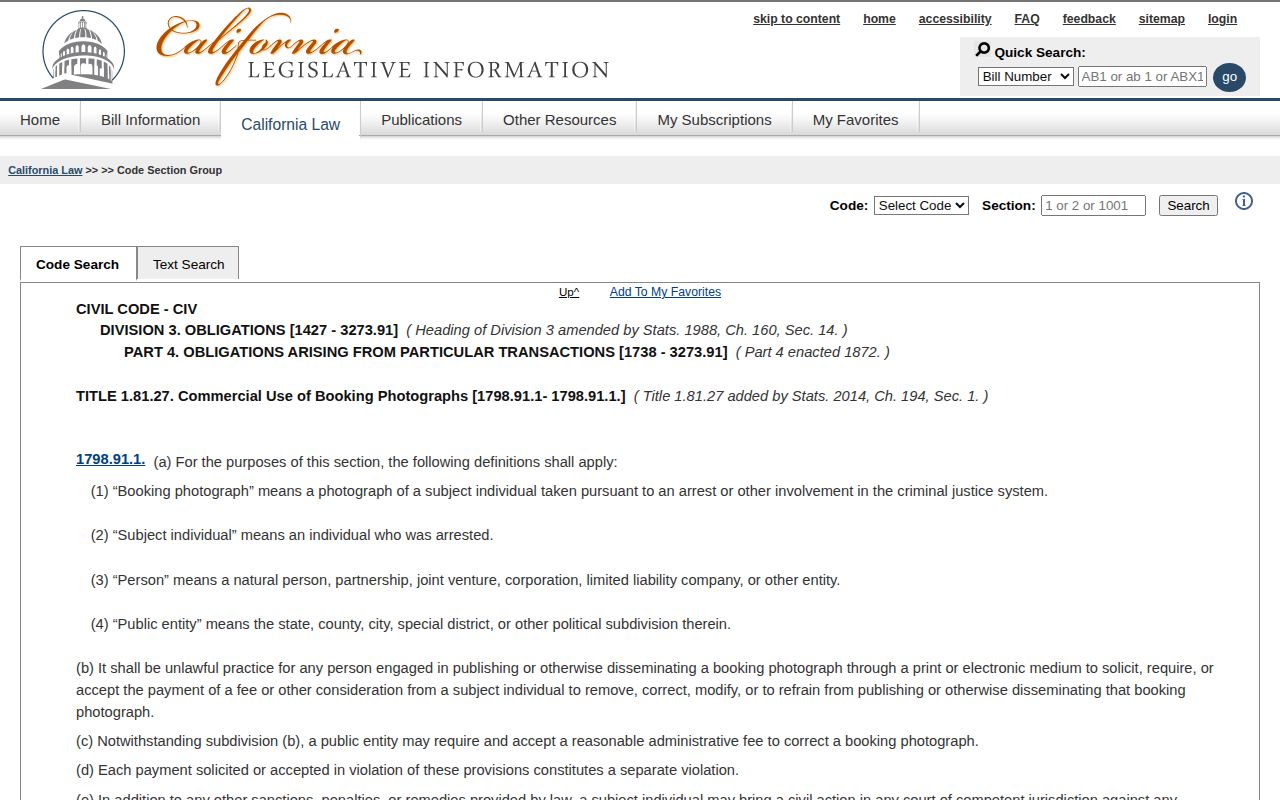
California treats arrests, booking photos, police social posts, and court record relief as separate legal territory. Government Code § 7923.610 sets the baseline for arrest information yet never lists the photograph. Civil Code § 1798.91.1 takes a different angle. It bars a publisher or distributor from charging the arrested person money or anything of value to remove, correct, alter, or withhold a booking image. The law supports a civil claim. Even so, it stops short of forcing automatic deletion from every source.
Relief depends on the type of record involved. Penal Code § 851.91 may allow sealing after an arrest that never led to conviction in qualifying circumstances. Penal Code § 1203.4 can dismiss many eligible convictions, but dismissal is not erasure. Juvenile sealing runs on its own procedures. An expungement is post-case relief whose effect depends on the statute and the order. No path promises that every copied image vanishes overnight.
The California Courts arrest-record sealing instructions point to forms CR-409 and CR-410 and walk through service rules. Start with whoever controls the source. Send official errors to Sheriff Records, use the court process for court relief, and use a publisher's free correction or removal policy for a copied record. Never pay a booking-photo publisher to act on the photographed person's behalf. If the source gets corrected or removed, Google and Bing offer outdated-result tools, though those only change search copies, not the source record itself. The official Civil Code page shows the anti-payment rule in its full legal context.
Older San Mateo County Mugshots
A vanished web page is not a destroyed file. The county has never published a retention number for its booking photos. Sheriff procedures do confirm one thing: images linked to booking numbers live inside inmate records, along with fingerprints. The current-custody locator was never meant to serve as a history archive. Once someone is released, request the booking file directly. Ask Records whether the adopted schedule still keeps it available.
Old court matters belong to the Superior Court. Prison-era photos are a different animal. The California State Archives holds Folsom and San Quentin identification cards and albums, some tagged with the committing county. A card from San Mateo County is still a state-prison record, not a county-jail mugshot. State model retention guidance offers useful benchmarks, but it can't prove what the Sheriff actually does locally.
Find San Mateo County Busted Mugshots
Where you look first depends on timing and custody status. Someone just reported arrested may surface in a city police release, a weekly newsletter, or a rolling activity log before anywhere else. A person still held after booking should appear in the Sheriff locator. Released individuals may drop out of that tool entirely. Their booking record remains requestable all the same. The Superior Court comes later, recording the filed case and how it resolves.
- Check the responsible city police source for incident context. San Mateo uses event releases, Daly City issues a generally weekly newsletter, and Redwood City keeps rolling 30-day media logs.
- Search the official Sheriff locator with exact first and last name. Use optional details or phonetic matching only when needed.
- Compare the listed facility, pending charge, custody status, next court date, and bail. Call the 24-hour custody line at 650-363-4000 extension 6070 when the online result is unclear.
- Use MIDX to locate the filed case, then Odyssey or the clerk to check the register of actions and disposition.
- For a released person or the actual San Mateo County busted mugshot, request the Sheriff’s daily log, booking record, and specific image.
County tools only cover county custody. State prison, federal prison, and immigration detention each run on separate systems. CIRIS tracks people in California's sentenced prison population. The Bureau of Prisons locator handles federal prisoners. ICE maintains its own civil custody search. A blank county result proves none of those agencies is holding the person.
Where San Mateo Arrest Records Appear
Start with official sources, since each channel answers a different question. News coverage and third-party copies can supply leads. Still, they often lag behind a release or a court outcome. No single public tool in San Mateo County combines every arrest, photo, custody change, and final disposition.
| Channel | Photo? | Best use |
|---|---|---|
| Sheriff inmate locator, official | Not advertised | Current county custody, facility, charge, status, court date, and bail. |
| City police publications, official | Varies | Incident context before or outside a jail booking; not complete rosters. |
| Sheriff Records, official | Request separately | Daily logs, released bookings, and review of a specific image request. |
| Superior Court, official | No mugshot function | Filed case, register of actions, later events, and disposition. |
| CDCR CIRIS, official | No documented locator field | People sentenced to state prison, not ordinary county bookings. |
| Local news, independent | Varies | Reported incidents with uneven city coverage and no complete booking list. |
| Recently Booked, unofficial | County says none supplied | A secondary 30-day county page that may be incomplete, delayed, or detached from court results. |
| Mugshots.com, unofficial | Historical entries vary | An apparently stale county archive concentrated in older years, not recent arrest proof. |
The San Mateo Daily Journal police page is the strongest independent blotter layer in the county. Its roundups run roughly weekly and rarely include mugshots. The Redwood City Pulse crime archive adds steady Redwood City coverage, frequently drawing on agency or prosecutor sources. Patch contributes occasional local stories. None of these amounts to a complete arrest roster, and photo availability varies widely.
Aggregators tell a similar story of gaps. The Recently Booked county section is the only current-looking aggregator page that checks out, and it plainly states the county does not provide mugshot images. Its listings can also be incomplete or stale. The Mugshots.com county section skews historical, with entries clustered between 2004 and 2016. No local San Mateo County section could be verified for Busted Newspaper, Arrests.org, or Mugshots.zone, so treat none of them as a local source.
Busted in San Mateo County Custody
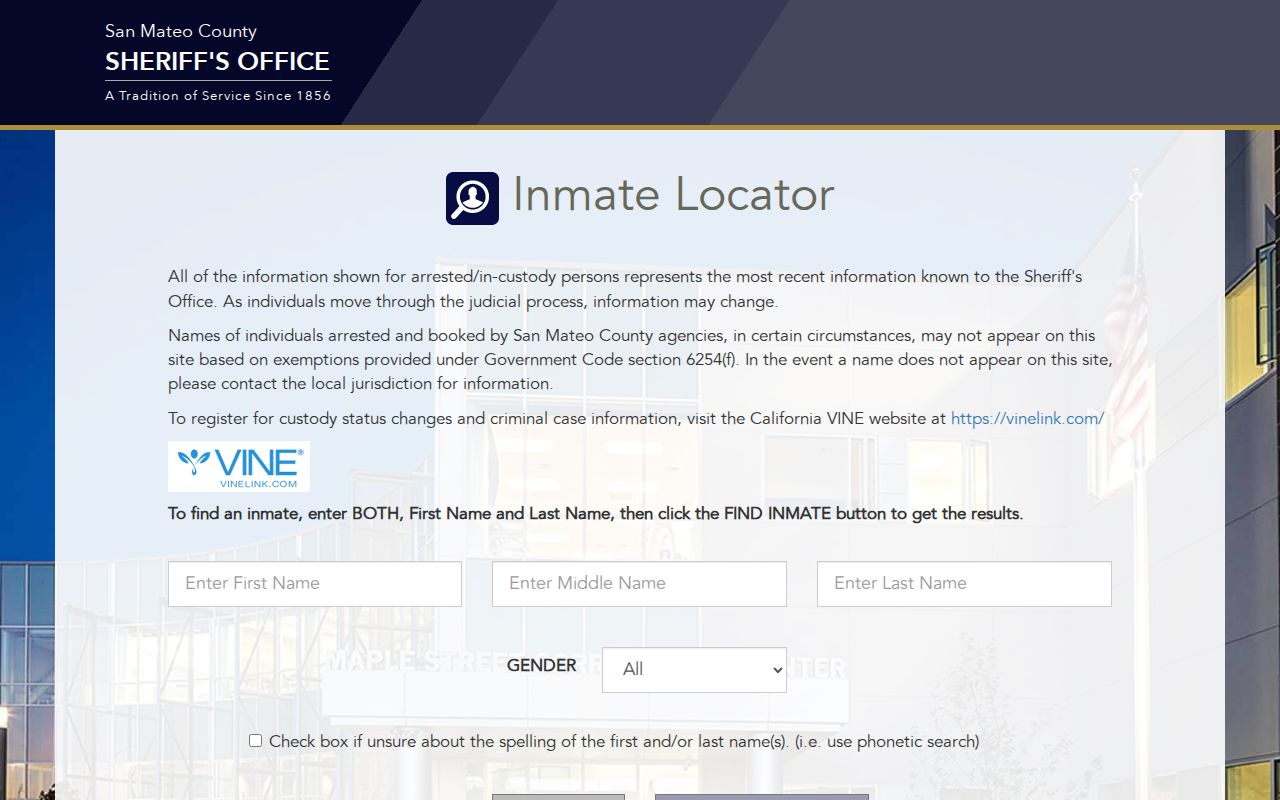
For people the Sheriff currently lists as arrested or in custody, the San Mateo County inmate locator is the official roster. It advertises itself as real time. No specific refresh interval is published. There is no stated archive of released people and no online retention window. A transfer or a release can make someone vanish from public view, even while the booking file stays on hand at the agency.
| Search field | Required? | Use |
|---|---|---|
| First name | Yes | Enter the known spelling. |
| Last name | Yes | Required with first name. |
| Middle name | No | Narrows similar names. |
| Gender | No | Optional result refinement. |
| Phonetic matching | No | Helps when spelling may differ. |
Search with the exact first and last name first. Too many hits? Add a middle name or gender, and try phonetic matching for odd spellings. Check the facility, status, charge, court date, and bail against what you know. Then verify the filed case through the Superior Court. Some names get withheld under law, so an empty result is never a final answer. The official inmate search interface reflects the roster's name-based design.
Why the Busted Image Is Missing
Here is the county's records quirk. Internal policy ties intake photos to the booking number, yet the official locator announcement lists no photo field at all. The advertised results cover facility, pending charges, custody status, next court date, and bail. That gap doesn't mean staff skipped the intake photo. File existence and web publication are simply two separate questions.
Does the roster show every booking photo? No photo field is promised. Use the locator to pin down current custody and booking context. If the image matters, send Records a request with the name, date, booking number, and arresting agency, and let the Sheriff apply the relevant release rules and exemptions.
Note: No Sheriff jail-search app was found; SMC Service Connect provides reentry help and is not an inmate or mugshot search.
Who Got Busted in San Mateo County
Want to know who got busted in San Mateo County recently? No single public feed covers it. The Sheriff Crime Data Portal counts incidents and crimes, not jail bookings, so the two never line up perfectly. A reported crime can end with no arrest. A booking can show no matching crime-map entry. Treating either one as a full arrest log mixes apples and oranges.
For the past day or two, start with the responsible city publication and then the name-based locator. Daly City’s Crime Newsletter runs roughly weekly, and Redwood City posts a 30-day media log. San Mateo’s releases follow no fixed schedule. For someone already released or an older booking, search MIDX and Odyssey, and ask the Sheriff for the daily log covering a specific date range. Request the booking photo separately; the log’s public fields do not spell it out.
San Mateo County Booking Facilities
Two jails handle San Mateo County bookings. Maguire Correctional Facility sits at 300 Bradford Street in Redwood City. It is the Sheriff's main jail and the main booking and release point. Most of its population is men awaiting court or serving county time. Maple Street Correctional Center, at 1300 Maple Street, holds men and women in pretrial, sentenced, and transitional settings. One number reaches both: 650-599-3000.
A transfer between them can make an older reference look wrong. The locator's current facility field beats an earlier city release for finding someone today. When police say "San Mateo County Jail," they nearly always mean this centralized Sheriff system, not a city lockup. Not every police event becomes a roster entry, either. Citations, quick releases, and hospital stays can keep a case out of the jail records entirely.
After San Mateo County Booking
California Penal Code § 825 sets the clock. A person must go before a magistrate without needless delay, within 48 hours, Sundays and holidays excluded under the statute's court-session rules. That is not a promise of exactly 48 clock hours in every case. Arraignment is where the court takes up the filed case. Bail is just a release condition set under law.
The record path runs arrest, booking, arraignment, then outcome. Prosecutors can decline to file, change counts, or dismiss. Judges and juries can acquit. For what happened after the jail event, the Superior Court record beats the booking file.
San Mateo County Court Records
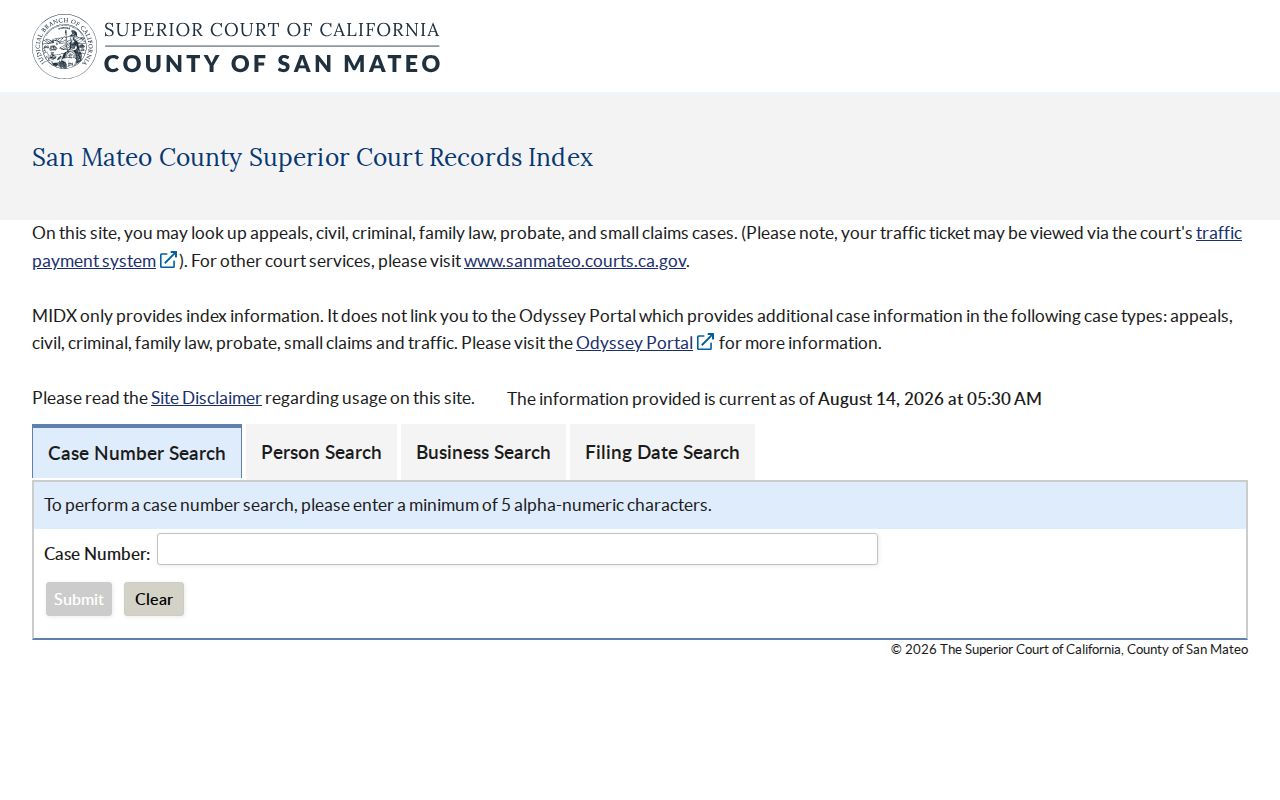
San Mateo court access works in two layers. MIDX is the broad index. It allows searches by case number, person, business, or filing date. Name searches need at least two characters per field. A filing-date search spans no more than five calendar days. The Odyssey Public Portal offers richer case and register-of-actions detail for public, nonsealed cases, though criminal documents generally are not shown remotely. Criminal matters filed before 1993 call for help from the clerk.
The MIDX court index screen makes one thing clear. A case search comes after a jail search, not instead of it.
- Booking
- Jail intake that creates the booking record and identifying images.
- Arraignment
- The first court stage where filed charges are addressed.
- Bail
- A court-set condition that may permit release while a case is pending.
- Disposition
- The later outcome, such as dismissal, acquittal, plea, or conviction.
- Expungement
- A form of post-case legal relief whose effect depends on the governing order and statute.
Busted, Released, or Transferred
One person can pass through several systems, and each record freezes a different moment. Check the current custody state first, then make sense of any missing result.
Just arrested: Start with the responsible city police release, newsletter, or log. Jail acceptance and booking may not be finished yet.
In county custody: Use the Sheriff inmate locator. The final case outcome, and any unadvertised booking photo, are separate questions.
Released from county jail: Turn to Sheriff Records, MIDX, and Odyssey. Release does not make every requested item disclosable.
Sentenced or transferred: Use CDCR CIRIS for state prison, or the right BOP, USMS, or Ice channel for federal or immigration custody.
State and federal locators answer a different question. The California Incarcerated Records and Information Search shows name, age, CDCR number, current location, admission date, county of commitment, and parole-eligible month and year for the state prison population. No photo appears among its public fields. CDCR keeps a separate identification-photo policy with safety and investigative exceptions. The Bureau of Prisons locator also lacks a photo field. It mostly covers sentenced federal prisoners. ICE's locator handles civil immigration custody, not county criminal outcomes.
San Mateo County Custody Alerts
Stop refreshing the San Mateo County roster all day. Set up custody notification instead. The locator and the District Attorney's Victim Services program link county custody data to California VINE-style release notices. Use the locator or call Victim Services at 650-363-4424. Have the person's name, date of birth, and/or inmate number ready.
Know what each tool does. This channel alerts you to a release, not to a booking photo. SMC Alert covers geographically relevant emergencies. It does not track who got busted or let go. Sheriff social accounts post selected agency news, but California's social-media photo rule limits their value as a mugshot source. Match every alert to its real purpose.
Note: Custody status can change quickly, so confirm a release or transfer with the Sheriff rather than relying on an old saved result.
Busted Mugshots Across San Mateo County
San Mateo, Daly City, and Redwood City each handle arrest information differently. None of the three runs its own jail roster. San Mateo Police posts press releases about individual incidents. Once someone enters county custody, the Sheriff side takes over, mainly at Maguire Correctional Facility. The San Mateo Busted Mugshots page walks through that city-to-county handoff.
Daly City Police takes a different route. Its Crime Newsletter comes out roughly once a week instead of offering a live booking list, and the city's own inmate-locator page points straight to the county tool. Redwood City Police keeps media logs that roll back 30 days, showing general police activity rather than jail intake. The Redwood City Busted Mugshots page digs into that city log. Daly City's page sits under the Cities menu. In any of the three cities, tracking someone who was released may mean a Sheriff records request plus a court search.
Why Police Mugshots May Vanish
Don't count on a police Facebook post as a lasting San Mateo County busted mugshot archive. Penal Code § 13665 sharply limits what agencies can share on social media. Booking photos from nonviolent arrests generally stay off those platforms unless the person is a fugitive, poses an imminent threat, a court orders publication, or some urgent circumstance applies. Even when a covered photo does go up, the agency normally has fourteen days to pull it back down unless an exception still holds.
The statute only reaches social media, though. An agency's own website and its internal booking files sit outside the definition. That's why an image can disappear from a department's feed while the underlying record stays intact at the Sheriff's office. For current custody, use the locator. For the filed case, go to the court. For the photo itself, ask Records. An old social post proves nothing about a person's status today.
Note: Sheriff social channels and SMC Alert carry public-safety news, but neither is a complete arrest or booking-photo feed.